

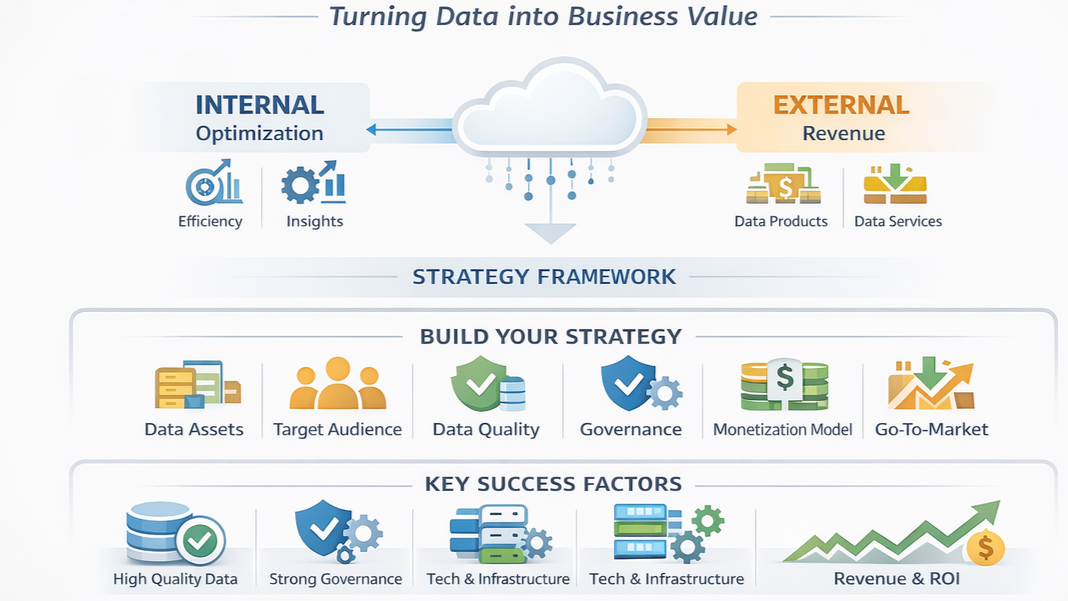
Turning Data into Measurable Business Value in the AI Era
In today’s digital economy, data is no longer just an operational byproduct — it is a strategic asset. Organizations that successfully monetize their data unlock new revenue streams, optimize costs, and gain a sustainable competitive advantage.
Yet many companies sit on vast amounts of data without a clear plan to turn it into value.
A Data Monetization Strategy is a systematic and structured approach to converting raw internal data into measurable business outcomes — from cost optimization and operational efficiency to external revenue generation through data sharing, products, and services.
The question is no longer if you should monetize your data — it’s how.
The Two Paths to Data Monetization
Most successful organizations pursue both internal and external monetization.
1️⃣ Internal Data Monetization
Using data to improve performance and reduce costs
Internal monetization focuses on leveraging data to drive smarter operations and better decisions.
Value drivers:
- Process optimization
- Improved operational efficiency
- Data-driven decision-making
Real-world examples:
- Predictive maintenance reducing equipment downtime
- Customer analytics improving retention and lifetime value
- Supply chain insights lowering inventory costs
👉 Internal monetization often delivers the fastest ROI because it leverages existing data without regulatory complexity.
2️⃣ External Data Monetization
Turning data into a revenue-generating asset
External monetization involves sharing or commercializing data and insights with third parties.
Common models:
- Sharing data or insights with partners
- Selling or licensing data as a product
- Data-as-a-Service (DaaS) via APIs and subscriptions
Examples:
- Retailers selling consumer insights to suppliers
- Financial institutions licensing risk and fraud data
- Mobility platforms offering traffic data via APIs
👉 External monetization transforms data from a cost center into a profit center.
How to Build a Data Monetization Strategy
A successful strategy requires a structured approach.
1. Identify and Build Data Assets
Start by cataloging your data sources and evaluating their potential value:
- Customer data
- Operational data
- Transaction data
- Sensor and IoT data
2. Define the Target Audience
Who benefits from your data?
- Internal teams
- Strategic partners
- Industry participants
- Developers and platforms
Understanding the audience shapes packaging, pricing, and delivery.
3. Improve Data Quality
Monetizable data must be: ✔ Accurate ✔ Complete ✔ Consistent ✔ Timely
Poor data quality erodes trust and limits adoption.
4. Establish Data Governance
Strong governance builds trust and ensures compliance:
- Privacy and consent management
- Security and access controls
- Regulatory compliance (GDPR, CCPA, industry standards)
- Clear data ownership
5. Choose Monetization Methods
Determine whether value is:
- Direct — selling data, subscriptions, APIs
- Indirect — improving products, reducing costs, enhancing customer experience
6. Define Your Market Strategy
Develop pricing and packaging models:
- Subscription tiers
- Usage-based pricing
- Partner distribution channels
- Marketplace listings
A Practical Data Monetization Framework
A structured framework ensures execution and scale.
🔹 Assess the Current State
Evaluate existing data assets, infrastructure, and gaps.
🔹 Align with Business Goals
Define success metrics such as:
- Revenue growth
- Cost reduction
- Market differentiation
- Customer experience improvements
🔹 Implement Data Governance
Create policies for ethical, secure, and compliant data use.
🔹 Modernize Technology & Infrastructure
Adopt scalable platforms such as:
- Data Lakes
- Data Fabrics
- Delta Lake architectures
- Data Mesh frameworks
These enable secure, governed data sharing at scale.
🔹 Define Go-To-Market (GTM)
Build revenue streams through:
- Data marketplaces
- API ecosystems
- Partner channels
- Embedded analytics
🔹 Measure ROI
Track success with metrics such as:
- Revenue from data products
- Operational cost savings
- Adoption and usage rates
- Customer retention improvements
Technology Foundations That Enable Monetization
To deliver data as a product or service, organizations need modern platforms that support scalability, governance, and accessibility.
Key architectures include:
- Data Lakes for centralized storage
- Data Fabrics for unified access
- Delta Lake for reliability and performance
- Data Mesh for domain-driven ownership
Analytics built on these platforms should deliver on-demand insights that can be securely shared with internal and external consumers.
The Power of Ecosystems in Data Monetization
Data monetization does not happen in isolation. Ecosystems and partnerships amplify reach and value.
Ecosystem benefits:
- Marketplaces connect data producers with consumers
- Partners extend distribution and integration
- APIs enable developers to build new applications
By publishing data through marketplaces, APIs, or data marts, organizations create seamless connections between producers and consumers.
What Success Looks Like
A successful data monetization strategy:
✔ Aligns with business goals and market demand ✔ Ensures strong governance and trust ✔ Delivers high-quality, usable data ✔ Enables scalable infrastructure ✔ Provides clear revenue and ROI metrics ✔ Leverages ecosystems for distribution
Final Thought
Data monetization is not just a technology initiative — it is a business transformation strategy.
Organizations that treat data as a product, invest in governance and quality, and leverage ecosystems for distribution will unlock new growth opportunities and sustained competitive advantage.
The leaders of the AI era will not be those with the most data — but those who know how to turn data into value.